






What Was Driving A Vehicle Like in the Early Days of Motoring?
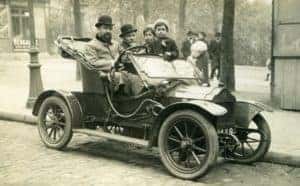
What an age we live in, especially when it comes to today’s advanced cars, trucks, vans, and SUVs! From heavy-duty pickup trucks to sporty, fuel-efficient compact sedans, the choices of what to drive these days are almost endless, along with the features and technology offered by today’s cars as well. The American auto industry has grown along with our country and has changed right along with the way we travel.
Have you ever wondered what it was like to drive as society began to accommodate the automobile, the newfangled contraption that would soon change America and the world? Let’s examine how early modern American society became mobile and handled this significant cultural phenomenon.
HORSELESS CARRIAGE: At the beginning of the 20th Century, the primary mode of family transportation in the U.S. – besides walking, of course – was traveling by horse-drawn wagon or buggy. In 1900, a basic buggy cost around $50 (about $1,400 today) and could be driven by almost anyone, even children. The age of the horse-drawn carriage was coming to an end by the early 1910s, however, as the number of automobiles on the road surpassed the number of horse-drawn conveyances. In 1909 there were 200,000 motorized cars in the United States according to the Automobile Club of America. A short seven years later, that number had ballooned to 2.25 million automobiles.
TRAFFIC LAWS? NOPE: As the automobile industry and automobile culture were taking off, placing two million vehicles out on the road, one thing that had to be sorted out was the rules of the road. At the beginning of the 20th Century, there were no traffic laws to speak of, turning big-city intersections into noisy, dangerous, potentially-deadly chaos. Can you imagine trying to drive if there were no stop signs, traffic lights, yield signs, driver’s licenses, posted speed limits, or even marked lanes in intersections? That was the challenge facing early drivers as the rapid change in America’s primary mode of transportation outpaced the creation of safety laws to regulate the new kind of traffic. Luckily, cities soon got the message and began developing the familiar traffic safety signs we know today, including…
OUR OCTAGONAL-SHAPED FRIEND: Try to imagine driving before the use of stop signs! The Automobile boom was well along by 1915 when the first vehicle stop sign was installed in the state of Michigan. The original stop sign was the familiar eight-sided design, though slightly smaller than today’s signs. Instead of bright red, the earliest stop signs were black with white lettering. The idea worked so well that by 1922, stop signs became standardized and adopted throughout America, though most would be yellow well into the 20th Century. The octagonal shape of the original was retained to be easily identifiable to drivers facing the back of the sign, letting them know that oncoming drivers were supposed to stop and allow them to proceed.
MAY I SEE YOUR DRIVER’S LICENSE? In the early years of the automobile, some states required a driver’s license, but primarily as a form of identification, not as proof that the operator had any training in vehicle operation or highway safety. For example, Missouri required driver’s licenses in 1901 but didn’t make people pass a driving test proving they could safely operate an automobile until 1952. Without even the basics of how to drive grasped before people got behind the wheel, early drivers frequently engaged in careless behaviors which resulted in quite a number of fatal vehicle accidents. Early driver’s licenses didn’t even include a photo of the driver, making them easy to fake or loan to a friend. Yikes!
SAFETY, PLEASE! By the 1920s, the nation was very concerned about the lack of traffic safety. The U.S. Secretary of Commerce, future president Herbert Hoover, spearheaded legislation to put traffic safety measures into practice for citizens and the auto industry. As a result, car manufacturers began to adopt many of the basic safety features we still rely on today, including turn signals, brake lights, and dimmable headlights. States also began requiring mandatory driver’s education courses to be completed, along with exams on on-the-road tests to prove a person had the knowledge and skills required to acquire a driver’s license. Soon, more strenuous traffic laws were formulated to put in check dangerous behaviors like speeding and drunk driving.
How Americans survived the early years of the automobile is anybody’s guess, but what significant and marvelous contributions the automobile has made to the growth of our nation! We at Hebert’s Town and Country Chrysler Dodge Jeep Ram in Shreveport hope you have enjoyed this piece of American and automotive history. And when you are ready to reach a new personal milestone with the purchase of a versatile Jeep Wrangler, aggressive Dodge Challenger, or tough-as-nails Ram truck, we make it simple for our customers through our Online Shopping Program. It’s a wonderful and easy tool to use that will help you explore payment options and financing, without ever leaving your home. We look forward to exceeding your expectations, at Hebert’s Town and Country CDJR in Shreveport.


0 comment(s) so far on What Was Driving A Vehicle Like in the Early Days of Motoring?